Krisztián Hadi

2016 · Warface (Crytek)

Giving players a trading marketplace that boosted credit sales by 30%

A player-to-player auction house for the items you had very little chance of getting from boxes. I designed it and gave the front-end team UI support while they built it.

Role
Senior web designer, UI developer
Company
Crytek
Time
2016–2017
Outcome
Credit sales up 30%+ in the first month
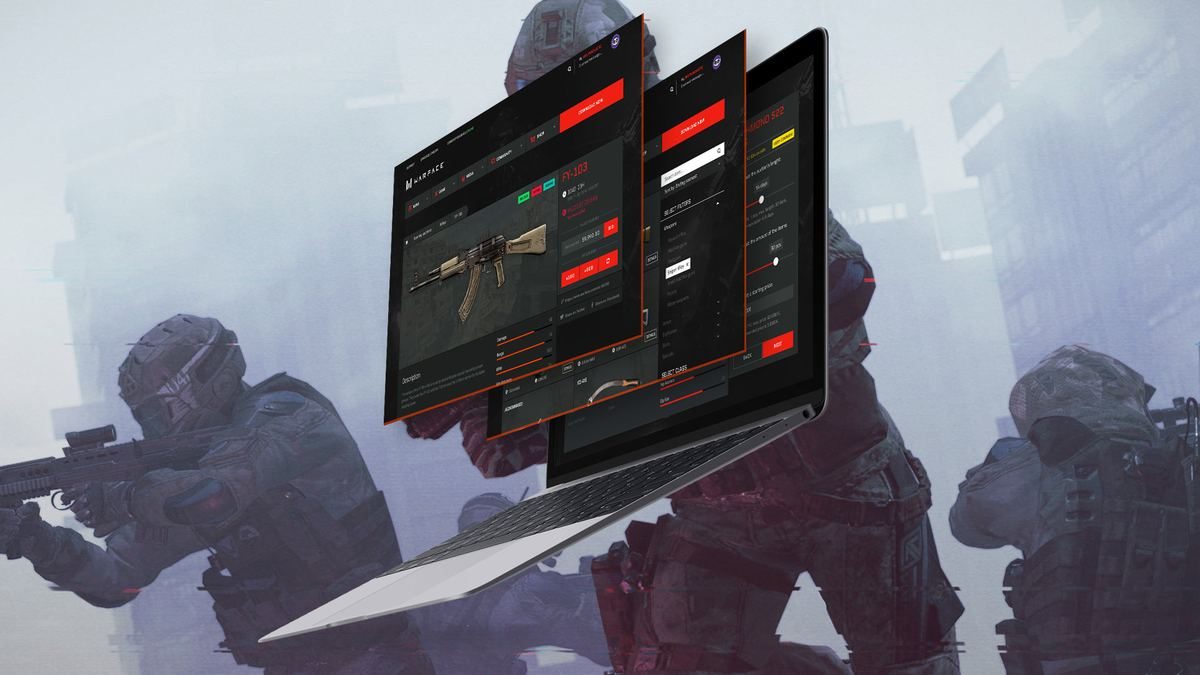
A Warface key art panel with soldiers and a tablet showing the game UI.
The web hub was already the centre of the community: news, a lively forum, credit purchases.

Problem

Warface is a free-to-play shooter that makes its money with micro-transactions. Players buy credits with real money and spend them on loot boxes, basically a slot machine. Credits can also be earned with playtime, but it's much slower and takes grinding.

The frustration starts when you've opened a thousand boxes and still don't have the item you want, while everyone shooting at you is running around with it. And there was no way to trade weapons or skins. Past a point you're not buying credits anymore, you're buying luck, and that feels like burning money. That frustration ends two ways: people quit, or they stop buying credits.

Important note: Warface had no pay-to-win items. All weapons and skins were aesthetic upgrades with the same stats: seasonal editions, gold skins and other rarities.

Just letting players trade brings its own risks. Once you can actually “take” items from someone, their account becomes a much more attractive target. Real money is at stake. And box sales, with the excitement around them, could die if players could just buy whatever they want. So we were dealing with a very delicate balance in the game's economy.

My role

I designed the auction house, from research and flows to mockups for every step, and handed them to the front-end devs in two phases. First I made the user flows and wireframes, so they could start laying the foundation and wire up the backend API that another team built in Kyiv.

In the second round I made the detailed UI designs, then jumped in to help with the small details, coding them by hand and handing them over.

This way the work could flow continuously: the devs could build while I was wrestling with marketing over branding and waiting for item assets from the game dev team.

Key decisions

  • Auctions. They're about as old as trade itself, so nobody needs a tutorial. They're exciting, and thanks to the time factor, safer than a simple 1-on-1 trade.
  • In the web hub, not the game client. Money and manpower were limited, and the hub team was more agile. The hub was already where players bought credits, so the decision was made to build it on the web.
  • Research first. World of Warcraft, Counter-Strike, Diablo, and obviously eBay, which got the most notes. I also pulled a few active players into informal interviews. That handful became my beta testers.
  • Flows before screens, so development could start before the final UI design.
  • A soft launch: a closed beta with the beta group, then a 1–2 week unannounced public run before marketing jumped in.
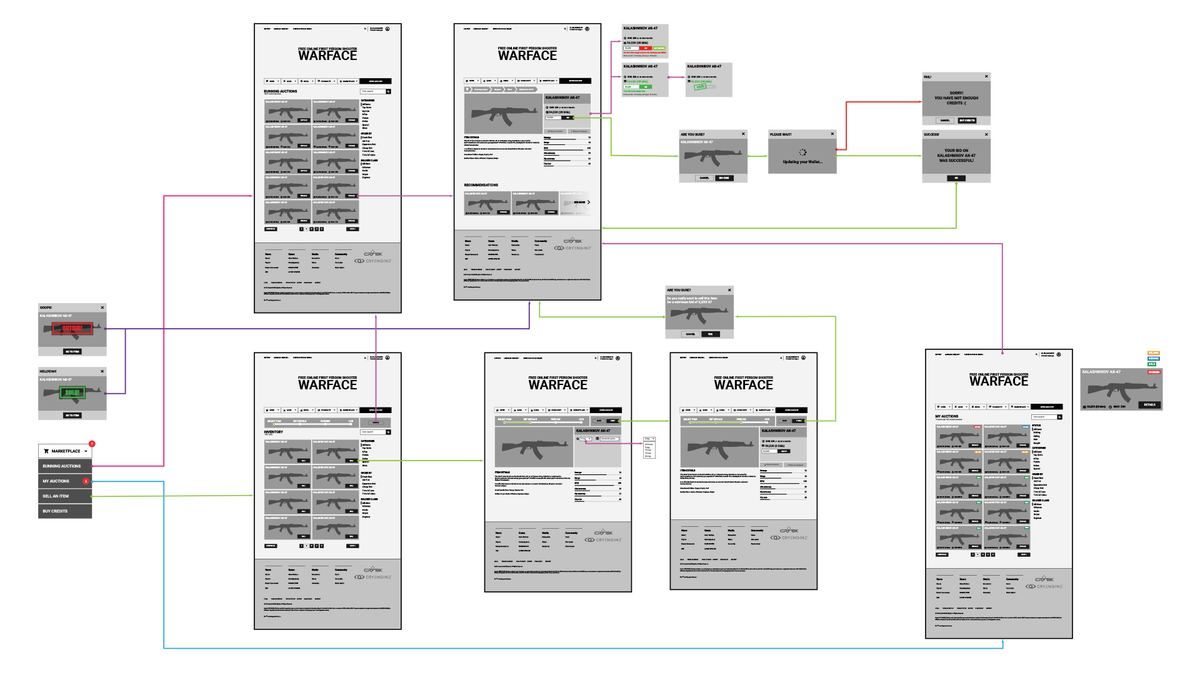
A user flow diagram for buying and selling in the auction house.
The buying and selling flows.
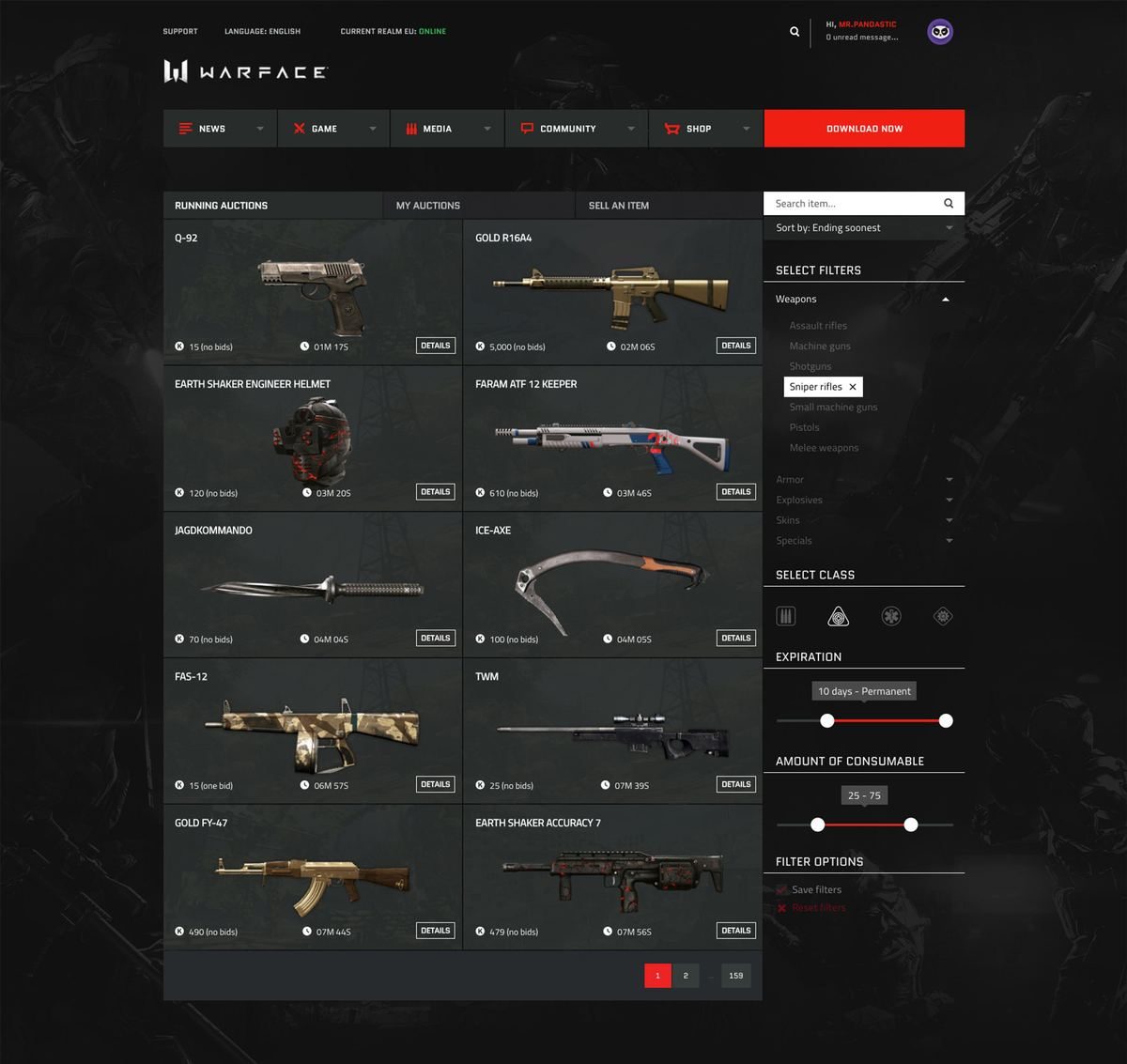
The auction house listing page with search, filters and item cards.
The main view: autocomplete search for the “sometimes confusingly named” special edition items, and filters by class. Shotguns were limited to the medic class, for example.
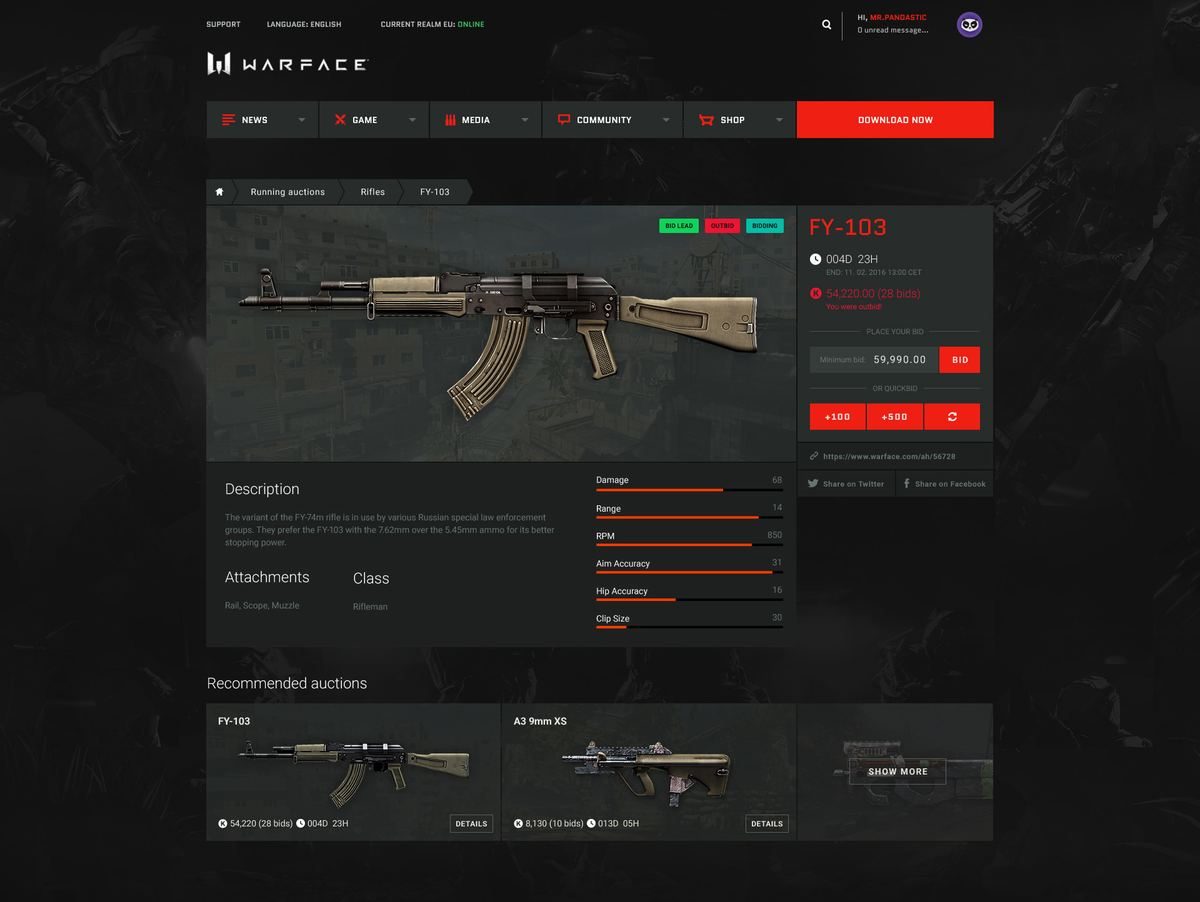
A single item page with in-game stats and the bidding panel.
The item view: all in-game stats, quick and automatic bidding for the last few minutes, and an instant credit top-up when the wallet runs low. That one turned out to be an excellent monetization spot.

Outcome

The auction house became a huge hit in the Warface community, and a regularly used feature. Credit sales went up 30%+ within the first month.

The reason is simple. Players already bought credits for loot boxes, but a box is a gamble. With bidding, the item they wanted was guaranteed, so they bought more credits to get it.

It was also very popular with purely free players, who grind to open boxes: when they got lucky, they could exchange their loot for credits, which kept the economy healthy and moving.

On top of that, it became a useful tool for the marketing team: they could create “Auction Exclusive” items and keep control over how rare they stayed. Some of the most popular ones were skins from Crysis, Crytek's most famous game.

Bonus

The community had more ideas than we could fit in the scope, so after launch, in my free time, I built two bookmarklets that turned the page into a more compact UI for the power users. A few screencaps survived on CodePen, so here they are.

Install

Superbrowse

Highlight

The two bookmarklets: Superbrowse packs the listing into a tighter grid, Highlight marks every auction of the item you're after.

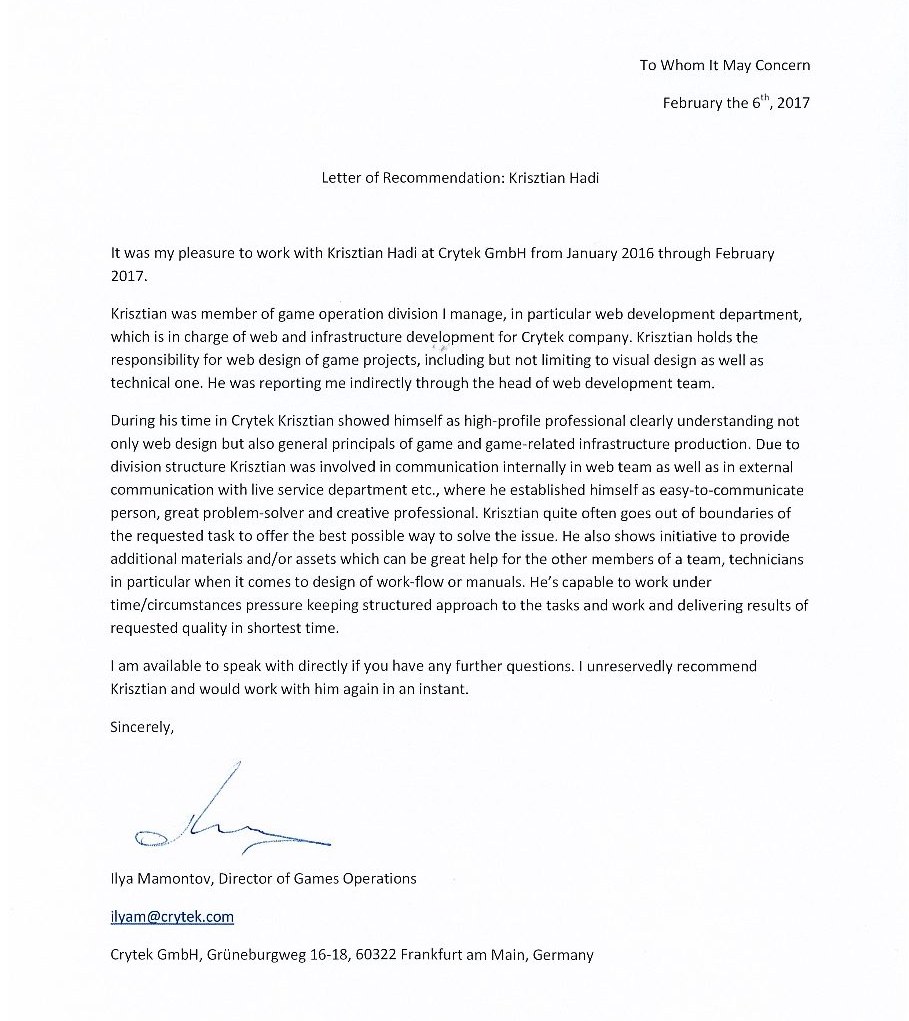
Letter of Recommendation

To Whom It May Concern
February the 6th, 2017

Letter of Recommendation: Krisztian Hadi

It was my pleasure to work with Krisztian Hadi at Crytek GmbH from January 2016 through February 2017.

Krisztian was member of game operation division I manage, in particular web development department, which is in charge of web and infrastructure development for Crytek company. Krisztian holds the responsibility for web design of game projects, including but not limiting to visual design as well as technical one. He was reporting me indirectly through the head of web development team.

During his time in Crytek Krisztian showed himself as high-profile professional clearly understanding not only web design but also general principals of game and game-related infrastructure production. Due to division structure Krisztian was involved in communication internally in web team as well as in external communication with live service department etc., where he established himself as easy-to-communicate person, great problem-solver and creative professional. Krisztian quite often goes out of boundaries of the requested task to offer the best possible way to solve the issue. He also shows initiative to provide additional materials and/or assets which can be great help for the other members of a team, technicians in particular when it comes to design of work-flow or manuals. He’s capable to work under time/circumstances pressure keeping structured approach to the tasks and work and delivering results of requested quality in shortest time.

I am available to speak with directly if you have any further questions. I unreservedly recommend Krisztian and would work with him again in an instant.

Sincerely,

Ilya Mamontov, Director of Games Operations
Crytek GmbH, Grüneburgweg 16-18, 60322 Frankfurt am Main, Germany